Showing posts with label Patients. Show all posts

Tuesday, June 6, 2017

Radiologists have an identity crisis

Here's a question that has been debated for several years: Should radiologists talk to patients about their imaging results? Citing several issues, I came down solidly on the "No" side in a 2014 blog post which you can read here.

Two major radiology organizations have committees looking into the concept, and a New York Times article said, "they hope to make their case [for it] by demonstrating how some radiologists have successfully managed to communicate with patients and by letting radiologists know this is something patients want."

However, a recent paper presented at the annual meeting of the American College of Radiology raised a new issue.

Apparently patients need more basic information before talking to radiologists—namely what exactly is a radiologist and what does a radiologist do?

A group from the University of Virginia surveyed patients waiting to have radiologic studies performed and came up with some remarkable results. Of 477 patients surveyed, only 175 (36.7%) knew that a radiologist is a doctor, and 248 (52%) knew that radiologists interpret images.

Based on those findings, the investigators developed an educational program of PowerPoint slides which was shown to a new series of 333 patients in the waiting room. When surveyed after viewing it, 156 patients (47.7%) said they were aware that a radiologist is a doctor, and 206 (62.2%) knew that radiologists interpret images.

Both responses were significantly better after the educational presentation, but still, less than 50% of patients identified radiologists as doctors. Maybe the problem was the PowerPoint. Maybe radiologists need to wear scrubs or drape stethoscopes around their necks.

This is only a small study from one institution. Nevertheless before taking the big step of talking with patients, it suggests radiologists need to do a better job of explaining who they are and what they do.

We surgeons think we have an image problem when people say to us, "Oh, are you just a general surgeon?" They don’t know what we do, but at least they know we are physicians.

Thursday, June 23, 2016

Recording patient/doctor encounters: A modest proposal

This is a guest post by Dr. Drake Ramoray (A pseudonym. He is not affiliated with the actor, character, the show “Days of Our Lives,” or NBC.)

I have been assured by a very knowing American of my acquaintance in London, that a young healthy child well nursed is at a year old a most delicious, nourishing, and wholesome food, whether stewed, roasted, baked, or boiled ...—Jonathan Swift

I have A Modest Proposal. I suggest we just videotape all patient/physician encounters. Why rely on a possibly low quality audio recording where exterior noises or interruptions could interfere with the quality? Furthermore, perhaps my comment that may or not be taken out of context will make more sense if one can see my body language. Even better, lets just transmit the videos directly to CMS and your insurance carrier so we can add additional layers of bureaucracy and non-medical personnel to the mix whose pay has to come out of physician charges, taxes, or patients' premiums.

Thursday, July 9, 2015

How to pick the leading physicians of the world


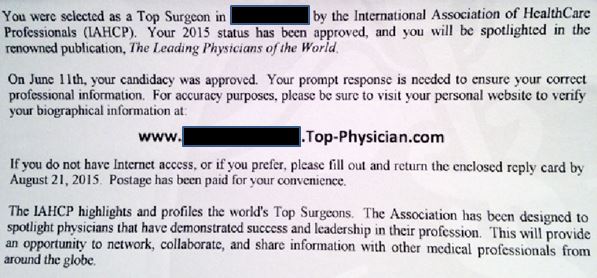
My "real life" self has been selected as a Top Surgeon in my city by the International Association of Healthcare Professionals (IAHCP). I will be spotlighted in the renowned publication “The Leading Physicians of the World.” Can you imagine?

As you can see, my candidacy [which I did not know was even a remote possibility] was approved on June 11.

The letter goes on to state that the IAHCP highlights and profiles the world’s Top Surgeons. The association features physicians who have demonstrated success and leadership in their profession. It even provides an opportunity to network, collaborate, and share information with other medical professionals from around the globe. [Just what I need—another social network of physicians.]

Inclusion in the book “The Leading Physicians of the World” is not only a tribute to my success, but is also a valuable resource for potential patients who are looking for a Top Surgeon in their area.

There is no charge for this honor.

I’m sure the organization did a lot of research before it approved my candidacy. I wonder how they missed that I’ve been retired from the practice of surgery for more than two years?

I thought this was remarkable, but last year New York Times writer Dr. Abigail Zuger easily topped me.

Last year, she wrote that a relative of hers had been named one of the world’s top physicians. All he had to do was to verify his biographical information, and he would be included in the same book and online reference mentioned above.

The good doctor wasn’t able to do so because unfortunately, he died 16 years ago.

What have we learned here?

As I have said on many occasions [e.g., here and here], one must take all ratings with a pinch of salt. 

Physician ratings? A truckload of salt.

Tuesday, March 31, 2015

Medicine, like air travel, once was fun

A Wall Street Journal blog about a reunion of employees of American Airlines lamented the good old days of air travel. Here's an excerpt:

"They came together to celebrate the days when flight attendants in white gloves hustled to serve you, gate agents doled out upgrades and arranged seating so families could be together, and managers worked flights with the single mission of ensuring excellent customer service."

The employees told tales of the fun they had and the camaraderie they shared. The passengers had fun too.

One retiree said of today's airline employees, "They don't look like they are having any fun at all."

Certainly the same can be said of today's passengers.

I'm usually not a fan of the airline-medicine analogy, but I'm going to make an exception here.

Back in the day, those of us in medicine had fun too. Don't get me wrong. It wasn't at the expense of the patients.

We always approached our patients with a proper attitude of respect. But it was OK to enjoy those encounters and also the fellowship of colleagues. We helped each other out, and we did it with spirit and camaraderie.

Not anymore.

All we read about now is how doctors are burned out, stressed, depressed. We battle with electronic records, hospital administrators, clipboard carriers, third-party payers, the government and just about everyone else.

What happened to the fun? It's all about the money.

David Shaywitz in Forbes: "The view from the front lines suggests that hospitals and care delivery systems are obsessing like never before on doing whatever they possibly can to maximize their revenue. They are consumed, utterly consumed, by this objective."

He added: "Many (I’d say most) providers and provider groups feel that they are locked in a deadly battle with payors (and increasingly, other providers) for their livelihoods; many feel they are having to work harder and harder to bring in the same (or less) money then doctors a generation ago. Many feel that the profession has lost the autonomy and respect it used to enjoy, and that providers are now viewed as mechanized assembly line workers, held to strict quantitative “quality” metrics that rarely capture the complexity, or essence, of the patient experience."

I believe what Shaywitz said is true. Can anything be done or is it hopeless?

Saturday, March 28, 2015

Follow-up: Meaningful Use Stage 3 is coming

Yesterday, I posted "Meaningful Use Stage 3 Is Coming: Should Be Fun" which discussed some onerous new rules that Stage 3 will impose including this one:

More than 25% of patients seen by an eligible professional (EP) or discharged from a hospital or emergency department (ED) must "actively engage" with their electronic health records (EHRs).

I said that in my experience most of the patients I took care of would have been unlikely to engage their EHRs and expressed concern that physicians would be penalized for their patients not reaching the 25% threshold.

A reader commented that the VA has had a patient portal called the Blue Button since 2010. He pointed out that in May of 2012, more than 500,000 unique patients had accessed their EMR. He meant this as a rebuttal to my opinion about the potential level of engagement.

However, it turns out that in 2012 over 6.3 million patients were treated by the VA system.  [See page 4 of this link.] If you divide 1 million by 6.3 million, you get 15.9%.

It seems like they have quite a way to go to get to 25%

I rest my case.

Friday, March 27, 2015

Meaningful Use Stage 3 Is Coming: Should Be Fun

An alert reader tipped me off to something many of you may not be aware of. Stage 3 of Meaningful Use is close at hand.

The "proposed" rules will be officially published on March 30. The good news is that comments will be received for a couple of months.

The bad news is that if the Office of the National Coordinator for Health Information Technology is anything like every other regulatory body I've ever dealt with [e,g., the ACGME's Residency Review Committee for Surgery], the "proposed" rules will be the real rules and the comments will be simply a way for disgruntled physicians to vent.

If you don't believe me about the venting, take a look at the 185 mostly negative comments posted on Medscape’s story about Stage 3.

Here are a few of the new rules that will be in effect by 2017 or sooner.

Thursday, March 19, 2015

Patients vs. doctors

A JAMA Viewpoint article suggests that doctors should be aware that patients may be surreptitiously recording their conversations. The author, a neurosurgeon, takes a very benign view of this issue and recommends that if a doctor suspects that patient is recording a conversation, "the physician can express assent, note constructive uses of such recordings, and educate the patient about the privacy rights of other patients so as to avoid any violations."

He also says this would show that the physician was open and strengthen the relationship between the doctor and the patient. I'm not so sure.

Here's a different perspective. If a patient is secretly recording a conversation, the relationship between him and the doctor is already in serious trouble. What I would do is to tell that patient to find another doctor.

If a patient asked me if it was OK to record our conversation, I would agree, but I would also want to record it to preserve a complete copy.

This comes on the heels of another privacy and trust question—should doctors google their patients? There is no consensus on this, but having read several discussions on the topic, most writers feel that googling patients should only be done for certain narrow reasons which you can read here.

Most medical societies have not weighed in on the subject, but I would guess when guidelines are published, they will discourage the practice. But of course, patients may google physicians at will.

Taking it to another level, Dr. Jeremy Brown, Director of the Office of Emergency Care Research at the National Institutes of Health, recently proposed that emergency physicians should be equipped with body cameras to record audio and video of patient encounters.

Leaving aside such questions as who owns the videos, how to store the vast amount of data, and what impact this would have on the performance of the individual physicians, body cameras would establish an adversarial relationship that is unnecessary for the overwhelming majority of doctors and patients.

A physician interaction with a patient begins on terms quite different from those of a police officer interacting with a suspect in which the adversarial relationship is already established. The increasing number of controversial and highly publicized cases involving police and suspects has resulted in a need to protect both parties. This need seems much less pressing in medicine.

Where does this end? Should all patients be equipped with body cameras too in case the physician copy "gets lost"?

It is sad to realize how far we have sunk as a profession.

Wednesday, March 11, 2015

Blame the patient

The other day some cardiologists on Twitter were discussing whether a patient should be blamed if a permanent pacemaker lead became displaced. The consensus seemed to be that it was probably poor placement (i.e., operator error), rather than patient behavior that caused leads to dislodge.

The discussion reminded me of an attending plastic surgeon of mine during my resident days. He was one of the most obsessive-compulsive people I ever met. When he applied a dressing, he always cut the tape with scissors instead of tearing it. He felt that torn tape looked sloppy, and that if a patient saw a ragged edged of torn tape, she might think that the surgical procedure itself had been done without meticulous care too.

When he wrapped a hand, he used a very bulky dressing with yards and yards of carefully cut, not torn, tape over the ace bandage to prevent from slipping or unraveling.

But my favorite eccentricity was what he told patients who had any sort of facial surgery. He had a thing about the role of movement of skin possibly causing scars to separate and permanently widen.

So he gave this written instruction to every patient who had so little as a facial mole removed, "Do not talk or chew for 10 days."

Think about it. Could any patient possibly comply with that? Some of us more cynical types figured that should a scar not have turned out perfectly, the conversation might have gone like this.

Surgeon: "About your scar, you must have talked or chewed during the first 10 days after surgery."
Patient (sheepishly): "Well doc, I must admit I did say a few words, and I had to eat something."

Tuesday, December 9, 2014

Should radiologists tell patients their test results?

Radiologists discussing test results with patients, a subject that has been lurking under the radar for a while, recently came to light because of an article in the New York Times. The idea is that patient anxiety while waiting to find out a test result could be alleviated by an immediate discussion with a radiologist.

That would be very nice, but there are potential problems, some of which are detailed in a post that appeared on the website of The Advisory Board and others in an editorial by radiologist Saurabh Jha accompanying a paper on the subject..

In the Times, Dr. Christopher Beaulieu, chief of musculoskeletal imaging at Stanford, said, “[T]he radiologist may be capable of transmitting the information but the obvious next question for the patient is, ‘What do I do now?’ which, as nontreating physicians, radiologists are not trained to answer.”

Wednesday, October 22, 2014

1 in 20 Americans are misdiagnosed every year

Really?

A paper published in April found that about 12 million Americans, or 5% of adults in this country, are being misdiagnosed every year. This news exploded all over Twitter. Anxious reports from media outlets such as NBC News, CBS News, the Boston Globe, and others fanned the flames.

The paper involves a fair amount of extrapolation and estimation reminiscent of the "440,000 deaths per year caused by medical error" study from last year.

Data from the authors' prior published works involving 81,000 patients and 212,000 doctor visits yielded about 1600 records for analysis.

A misdiagnosis was determined by either an unplanned hospitalization (trigger 1) or a primary care physician revisit within 14 days of an index visit (trigger 2).

A quote from the paper [Emphasis added] : For trigger 1, 141 errors were found in 674 visits reviewed, yielding an error rate of 20.9%. Extrapolating to all 1086 trigger 1 visits yielded an estimate of 227.2 errors. For trigger 2, 36 errors were found in 669 visits reviewed, yielding an error rate of 5.4%. Extrapolating to all 14,777 trigger 2 visits yielded an estimate of 795.2 errors. Finally, for the control visits, 13 errors were found in 614 visits reviewed, yielding an error rate of 2.1%. Extrapolating to all 193,810 control visits yielded an estimate of 4,103.5 errors. Thus, we estimated that 5126 errors would have occurred across the three groups. We then divided this figure by the number of unique primary care patients in the initial cohort (81,483) and arrived at an estimated error rate of 6.29%. Because approximately 80.5% of US adults seek outpatient care annually, the same rate when applied to all US adults gives an estimate of 5.06%.

Wednesday, October 15, 2014

Readmissions: Sometimes it's the patients

My Twitter friend Dan Diamond (@ddiamond) posted a picture of a slide that said a hospitalized patient was taught to inject insulin using an orange to practice on. When he was readmitted to the hospital with a very high blood sugar, it turned out that instead of injecting himself at home, the patient was injecting his insulin dose into an orange, and then eating it.

We've all heard stories about patients who took suppositories by mouth instead of the way they were intended.

Since doctors get blamed for just about everything, some would say that patients who take suppositories by mouth or eat an orange filled with insulin do so because they were not properly taught by their doctors (or nurses).

I have blogged before about the problem of who is at fault if patients do not follow up. Although I feel that much of the time it's the patient who decides not to return for follow-up, it seems prevailing sentiment and possibly even the courts say it's the physician who should be held responsible.

But how do you explain this? A study in Heart, a BMJ journal, found that of 208 hypertensive patients referred to a clinic for suboptimal blood pressure control, 52 (25%) were either completely or partially non-adherent [aka non-compliant] with their antihypertensive medications as determined by urine mass spectrometry.

The authors concluded that urine testing for medications or their metabolites would help doctors avoid ordering unnecessary investigations for patients whose blood pressures were not well-controlled.

The reasons for patient non-adherence were not mentioned. Could all 52 patients not have been told about the importance of taking their medications? I doubt it.

You might think the 15% who were partially non-adherent may have forgotten to take the drugs occasionally, but it turns out that most of those in this group took adequate doses of most of other their prescribed medications. This suggests that they selectively omitted some doses of one or more drugs.

The only explanation I can fathom for the 10% who had no traces of any BP meds in their urine is that they just said "to hell with it" and didn't take their meds at all.

I know someone with type 2 diabetes who doesn't watch her weight or what she eats and doesn't check her blood sugars. She says, "You've got to die of something. I'd rather live my life the way I want to."

Is it that doctors and nurses aren't educating the patients or are the patients at fault?

The answer to this question has important implications because of the newly established financial penalties for hospitals with high readmission rates.

Older methods that may improve adherence are tracking prescription refills and having pharmacists or nurses specifically assigned to explain medications to patients in detail.

Here's something that might help.

A recent meta-analysis showed that adherence to HIV/AIDS antiretroviral therapy was modestly improved when patients were sent reminders to take their medications by text message. Those who were more adherent had lower viral loads and better CD4 counts.

Of course, such an intervention assumes that patients have mobile phones or pagers capable of receiving texts, will check for messages, and will act upon the advice. Compared to patients with HIV/AIDS, those with hypertension might tend to be much older and possibly not as technologically savvy.

So what is the solution? I don't know, but sometimes the problem is the patients.

Monday, August 18, 2014

Are surgeons responsible for everything that happens to their patients?

Several months ago, a post called "Everything's my fault: How a surgeon says I'm sorry" appeared on KevinMD. It was written by a plastic surgeon who feels that no matter goes wrong with a patient, surgeons should never blame anyone else.

She gave some examples such as the lab losing a specimen, a chest x-ray that was ordered and not done, a patient eating something when he was not to be fed, and a surgeon having to cancel a case because the patient's blood pressure was elevated. She felt that all of these incidents should be owned by the patient's surgeon.

I agree that if I order a chest x-ray and find out later it wasn't done, I would accept the responsibility to have made sure it was done. I have always believed that you should not order a test if you aren't going to do something with the result.

But if the lab loses a specimen or a patient who was not supposed to eat does so, how is that my fault?

Friday, January 17, 2014

Non-English-speaking patients. Lost in translation?


What is one of the rules that medical people comply with the least?

My vote goes to "translation." The rule is that you must use a qualified medical interpreter for any interview or discussion with a patient who does not understand English.

How is lack of understanding defined? It is usually fairly obvious. If you aren't sure whether the patient gets it, he probably doesn't.

Why can't family members act as translators?

There is no guarantee that they will understand what is said or transmit it accurately to the patient.

What are the options?

You can summon a translator from the list of hospital personnel who have volunteered to translate. This works if the language in question is Spanish or maybe French. It's not often useful for Bengali or for most of the 13 or so national languages spoken in Mali.

The Joint Commission says if hospital employees are used, they must be qualified as translators and suggests ways that they can become qualified such as language proficiency testing, training in the practice of interpreting, interpreting experience in a health care setting and knowledge of medical terminology.

One website I found while researching this subject claims that the Joint Commission says all on-site interpreters must undergo an FBI background check. I could not verify this with the JC because its standards are only available if you pay. [Digression: If this is true, it is very interesting since doctors and nurses do not have to undergo FBI background checks.]

Many hospitals do not have formal training for interpreters nor are interpreters always available around the clock.

Sometimes hospital administrators take things too literally. In one hospital I know of, a fully bilingual surgeon was told he could not obtain an operative consent in Spanish (his native language) because he had not been trained as an interpreter.

There also are times when the hospital employee is not up to the task either because of education or attitude.

A hospital can contract with a service to provide interpreters via telephone. The advantages are that the interpreters are qualified and speak many different languages, far more than you might find among hospital personnel.

Among the disadvantages is the awkward nature of these conversations. If you use only one handset, you have to keep passing the phone back and forth and you can't hear what the interpreter is saying.

A two-handset phone set-up is somewhat better, but you have to find it. It is always stored in a different place on each floor of the hospital.

Accessing the service can be time-consuming. You must make an 800 call, log in, wait for the interpreter to join and so on.

Either in person or by telephone, the conversation can be frustrating.

I have had occasion to say something to the interpreter that took 2 minutes only to have the interpreter talk to the patient for 10 seconds. Here's a video example.

But the real problem is lack of true physician-patient interaction. You are both talking to someone else. Telling a patient she has cancer or what the risks and benefits of a procedure are is often accompanied by stunned silence from the patient. You really can't tell how much has been understood.

Also worth noting is that whatever the language, most of the time we then have the patient sign a consent form that is written in English.

You may have figured this out by now—many hospitals don't do any of this very well.

What do you do with a patient who speaks a language that even the telephone interpreter service doesn't provide?

We simply do the best we can. I'm not sure that any interpreter, phone or in person, can really communicate with some of these patients. 

Now that I think of it, I'm not sure how many English-speaking patients understand us either.

Thursday, December 26, 2013

Why do misconceptions about brain death persist?


On December 9, 2013, 13-year-old Jahi McMath underwent a tonsillectomy at a children's hospital in Oakland, California. She suffered postoperative hemorrhage and became comatose. She was declared brain-dead by doctors at that hospital on December 12th. This was later confirmed by a court-appointed outside consultant.

There are many issues surrounding this case. Was the tonsillectomy indicated? Some stories reported that it was done to improve her obstructive sleep apnea. Why wasn't she successfully rescued from her complication of bleeding? I can find no discussion about how she could have bled so much without intervention in any article about the case.

But one of the most distressing aspects of this poor child's demise is that despite many years of experience with brain death, it is still misunderstood by laypeople, the courts, and even some medical providers.

As of December 26th, 14 days after the brain death declaration, the child remains on a mechanical ventilator with apparently stable vital signs.

A lawyer for the family had petitioned the court for the outside expert's consultation and to prevent the hospital from disconnecting the child's life-support.

After all this time, a judge has finally ruled that the hospital may remove the life-support but not until December 30th to give the family time to appeal to a higher court.

What a shame. It is bad enough that this girl has died. But to realize that in 2013, society still cannot deal with the concept that brain death is "death" makes it sadder.

It may be a problem of terminology. When we say "brain-death," it somehow does not sound like real death.

The problem is compounded by other words used in this post such as "life-support" and "vital signs." These terms perpetuate the mistaken notion that life is still present.

The Harvard Criteria for brain death were written in 1968. That is 45 years ago. Why are we still debating this in court?

The answer is, we have failed to properly educate the public about this relatively straightforward fact.

It must be extremely difficult for this child's family to accept that the girl is dead after what many have called "routine" surgery. I feel very bad for them.

Something that has not been mentioned in any report about this case is another issue that society has trouble handling—organ donation. Perhaps the family should consider this. Those who have been in similar situations say that donating organs gives them some comfort in that part of their loved one lives on and that someone else has been helped.

I hope the higher court does the right thing and declines to review the case and that the family can eventually find peace.

UPDATE: December 27, 2013

According to the San Jose Mercury-News, the family says it has found a facility willing to provide long-term care for the girl. They want doctors at the Children's Hospital to perform a tracheostomy and a gastrostomy (semi-permanent feeding tube), which they have declined to do because it is futile.

The child's uncle is quoted, "It looks like we may have found a miracle to keep Jahi alive and to give her another fighting chance to wake up." I'm sorry to say that is not going to happen.

Also, the original surgery was much more than just a tonsillectomy. The girl underwent a full obstructive sleep apnea operation consisting of the following: adenoidectomy, tonsillectomy,  uvulopalatopharyngloplasty (UPPP), and submucous resection of bilateral inferior turbinates of the nose.