An interesting article on Stat News featured comments from both proponents and detractors. Here are some of them:

"Man is least himself when he talks in his own person. Give him a mask, and he will tell you the truth." Oscar Wilde
Showing posts with label Obesity. Show all posts
Showing posts with label Obesity. Show all posts
Monday, July 18, 2016
New weapon to battle obesity or folly?
The FDA recently approved the AspireAssist, a tube placed into the stomach through the abdominal wall enabling a patient to drain a portion of gastric contents after eating. The idea is to remove about 30% of food intake after each meal. Food must be thoroughly chewed and taken with plenty of water in order for the material to drain properly. The manufacturer suggests draining the gastric contents directly into a toilet.
When I first heard of this device three years ago, I expressed my usual skepticism. However, a recent multicenter study presented at this year’s Digestive Disease Week looked at the use of the AspireAssist with counseling to counseling alone found that morbidly obese patients who used the device lost more than 30% of their excess weight compared to only about 10% for those in the counseling group. Bear in mind that the figures are percent of excess weight lost, not percent of total weight lost.
An interesting article on Stat News featured comments from both proponents and detractors. Here are some of them:
An interesting article on Stat News featured comments from both proponents and detractors. Here are some of them:


Monday, September 14, 2015
Is obesity a disease, a disability, both, or neither?
In 2013, the American Medical Association recognized obesity as a disease. Dr. Peter Ubel, writing in his blog on the Forbes website, thought this was a bad idea. He feared that calling obesity a disease will result in people having less motivation to lose weight and cited a study which found that people who were told that obesity is a disease tended to be less concerned about their weight and when offered a sandwich for a hypothetical lunch, chose less healthy food.
Although he gave good reasons why obesity should not be considered a disease, he favored retaining the disease label because it would help reduce the stigma attached to obesity and build public support for programs to conquer obesity. I am not sure about that.
Back in December, the BBC reported that the European Court of Justice heard the case of a 352 lb Danish childcare worker who was fired from his job because he couldn't bend down to tie children's shoelaces. He denied the allegation.
The European Court "ruled that if the obesity of the worker 'hinders the full and effective participation of that person in professional life on an equal basis with other workers,' then obesity can fall within the concept of 'disability.'" Danish courts need to hear the case and decide if the worker is truly disabled. The ruling affects all other countries in the European Union.
The Editorial Board of the Chicago Tribune commented on the issue in a piece entitled "the dangers of treating obesity as a disability." It mentioned a Texas case in which a court said a company that dismissed a 600 lb materials handler could not do so because they had not tried to "find ways to help him perform his duties."
The Tribune article pointed out that one-third of Americans are obese with 15 million (7% of the population) classified as morbidly obese. The board felt that this was a potentially very costly expansion of the Americans with Disabilities Act, which they say was intended to help those who were disabled not by individual decisions, but rather were "victims of fate." It did not address the fact that many are disabled from smoking-related emphysema. Are they victims of fate or poor choices?
A recent editorial [full-text here] in the American Journal of Medicine took it up another notch. The author, Dr. Robert M. Doroghazi blamed obesity on eating more calories than one burns—a hypothesis held by many. Regarding the war on obesity, he said, "We will not make progress until we tell obese patients they eat too much, and it is their personal responsibility to eat less." Too harsh?
Disease, disability, both, or neither? What's your opinion?
Although he gave good reasons why obesity should not be considered a disease, he favored retaining the disease label because it would help reduce the stigma attached to obesity and build public support for programs to conquer obesity. I am not sure about that.
Back in December, the BBC reported that the European Court of Justice heard the case of a 352 lb Danish childcare worker who was fired from his job because he couldn't bend down to tie children's shoelaces. He denied the allegation.
The European Court "ruled that if the obesity of the worker 'hinders the full and effective participation of that person in professional life on an equal basis with other workers,' then obesity can fall within the concept of 'disability.'" Danish courts need to hear the case and decide if the worker is truly disabled. The ruling affects all other countries in the European Union.
The Editorial Board of the Chicago Tribune commented on the issue in a piece entitled "the dangers of treating obesity as a disability." It mentioned a Texas case in which a court said a company that dismissed a 600 lb materials handler could not do so because they had not tried to "find ways to help him perform his duties."
The Tribune article pointed out that one-third of Americans are obese with 15 million (7% of the population) classified as morbidly obese. The board felt that this was a potentially very costly expansion of the Americans with Disabilities Act, which they say was intended to help those who were disabled not by individual decisions, but rather were "victims of fate." It did not address the fact that many are disabled from smoking-related emphysema. Are they victims of fate or poor choices?
A recent editorial [full-text here] in the American Journal of Medicine took it up another notch. The author, Dr. Robert M. Doroghazi blamed obesity on eating more calories than one burns—a hypothesis held by many. Regarding the war on obesity, he said, "We will not make progress until we tell obese patients they eat too much, and it is their personal responsibility to eat less." Too harsh?
Disease, disability, both, or neither? What's your opinion?
Friday, March 14, 2014
Can dreaming about exercising lead to weight loss?
I was about to write one of my infrequent but famous spoof articles, and the subject was going to be losing weight by dreaming about exercising. For fun, I decided to search the Internet to see if anyone else might have had the same notion. To my surprise, they had. Here's what I discovered.
To be able to exercise while asleep, one must be able to have a so-called "lucid dream," which is described as being aware that one is dreaming while dreaming. According to a paper by Daniel Erlacher, 51% of 919 Germans who were questioned said they had experienced at least one lucid dream.
Apparently some lucid dreamers can also control the content of their dreams.
In the Harvard Business Review, Erlacher says, "In one experiment we asked participants to dream about doing deep knee bends. Even though their bodies weren’t moving, their heart and respiration rates increased slightly as if they were exercising."
We need to find a group of overweight people who are also lucid dreamers. Finding the former should be easy. If there aren't enough of the latter, subjects can be taught how to have lucid dreams in only 16 simple steps.
After explaining what a triathlon is, we tell them to dream about doing one every night for the next, say, 10 years. Would that work?
Probably not. A more scientific discussion of whether calories are actually burned while dreaming appeared in a blog called "The Naked Scientists." Someone asked whether running in a dream burned calories. They explained that while brain metabolic activity increases and a few calories are expended while dreaming, they doubt that there would be any meaningful effects on fitness levels or weight loss. Unless sleepwalking occurred, one of them said, with tongue-in-cheek.
I think the dream scenario is too complicated anyway.
Here's another potential solution.
An article on CNET is headlined "You could lose weight while your avatar exercises." Although that sounds like an exercise program that most couch potatoes could embrace, the study it refers to didn't exactly show what the headline said.
What it did show was that 8 women were recruited to watch animated avatars that they created exercise and eat reasonable portions of food. The women then "set their own weight loss and exercise goals, tracked their progress using some old-fashioned food and exercise logs" and lost an average of 3.5 lbs. over a 1-month period. Whether that weight loss continued for more months or was even maintained was not stated.
So do these shortcuts to weight loss really work? It's doubtful.
Dreaming about exercising or watching your avatar exercise probably isn't going to do it. I'm afraid you're just going to have to eat fewer calories than you burn.
Tuesday, November 19, 2013
Study shows paying people to lose weight works. Or does it?
A new study looked at the effect of paying people to lose weight.
The authors randomized 100 people with BMIs ranging from 30
to 39.9 into four groups. Two groups received weight-loss education, one group with
and one without payment. The other two groups received education plus behavior
modification with again one group receiving financial incentives and the other
not. To remain in the study, they were all supposed to have lost 4 pounds per
month. Patients in the two financial incentive groups received $20 per month if
they met their goal, and those not meeting the goal had to pay $20 per month
which was pooled for a lottery among the participants at the end of the study.
A significantly larger percentage of those receiving remuneration
completed the study. At the study's endpoint—12 months, the average weight loss
for those in the paid groups was about 9 pounds compared to just over 2 pounds
for the two unpaid groups. Using a two-way ANOVA, the incentives were estimated
to have led to a weight loss of 6.5 pounds, which was statistically significant
with a p value < 0.001.
The authors concluded, "Sustained weight loss may be
achieved with financial incentives."
The paper was presented at the American College of
Cardiology meeting last March and is available only in abstract form.
The study raises some questions.
The paid groups lost less than 1 lb per month. If the
subjects were to have lost 4 lbs per month, why didn't they lose a minimum of
48 lbs, which would be 4 lbs x 12 months?
How durable was the weight loss? In other words, after the
monetary incentive stopped, did the subjects regain the weight? It is
well-known that many people regain weight after they go off their diets.
Does this study actually show that education and behavior
modification are not very useful promoting weight loss? Then why should anyone
bother?
It's one thing to do a study of 100 people, but if money
truly is a good way to get people to lose weight, who is going to pay the millions
of obese people in the US?
But here's the real question. How clinically important is a
6 to 9 lb weight loss for someone with a BMI of say 35?
If a man is 5'8" tall and weighs 230 lbs, he has a BMI
of 35. If he loses 6 lbs, his BMI drops to 34. Does that decrease his risk for
diabetes or hypertension? I think not.
This may be another example of a statistically significant
result that is very likely not clinically important.
Monday, February 4, 2013
New weapons in the war against obesity
Just when you think you’ve seen everything, along comes the AspireAssist. This device, not yet FDA-approved, consists of a tube implanted in the stomach which leads to a port which is exposed on the surface of the abdomen.
Now, I’m not making this up.
You can eat whatever you want. Then 20 minutes after your meal, you attach a pump to the port and siphon and lavage the contents of your stomach into a bucket or basin, I guess. The manufacturer says that this will remove about a third of what is eaten leading to weight loss if done after every meal.
It doesn’t tell you how to gracefully dispose of the contents of the stomach, especially if you are dining at say, McDonald’s.
The only research on this product is in the form of a poster that was shown at a meeting of the Obesity Society in October of 2011. It was a randomized prospective trial of 11 patients who received the device plus “lifestyle intervention” compared to 7 patients who had only “lifestyle intervention.” It was funded by the maker of the device.
Ten subjects completed a year with the device vs. only 4 who stuck with the lifestyle intervention. Baseline characteristics were similar for the two groups. Percent weight loss and absolute weight loss were significantly greater in the device group. The average one-year weight loss was 20 kg.
However, 10/11 patients had pain more than 4 weeks after surgery and irritation and bleeding at the stoma occurred in about half the patients. Two had infections at the site. Constipation occurred in 6 patients and anemia in 4.
If you can stomach it, there is a video at the company’s website. Thankfully, it’s an animation.
Medgadget describes the concept as “high-tech bulimia.”
If that doesn’t appeal to you, how about something more simple?
Introducing the “smart fork.”
A flashing light and vibration tells you when you are eating too fast. It monitors how long it takes you to eat your meal. It has Bluetooth and USB connectivity so you can upload data to your phone or computer. Here’s an excessively overproduced video explaining it.
But wait, there’s more—it’s dishwasher safe, as a view from inside the dishwasher shows.
As far as I know, Ron Popeil has nothing to do with this product.
At least it looks a lot less messy than washing out your stomach through your abdominal wall.
I don’t think surgeons doing gastric bypasses have anything to worry about just yet.
Now, I’m not making this up.
You can eat whatever you want. Then 20 minutes after your meal, you attach a pump to the port and siphon and lavage the contents of your stomach into a bucket or basin, I guess. The manufacturer says that this will remove about a third of what is eaten leading to weight loss if done after every meal.
It doesn’t tell you how to gracefully dispose of the contents of the stomach, especially if you are dining at say, McDonald’s.
The only research on this product is in the form of a poster that was shown at a meeting of the Obesity Society in October of 2011. It was a randomized prospective trial of 11 patients who received the device plus “lifestyle intervention” compared to 7 patients who had only “lifestyle intervention.” It was funded by the maker of the device.
Ten subjects completed a year with the device vs. only 4 who stuck with the lifestyle intervention. Baseline characteristics were similar for the two groups. Percent weight loss and absolute weight loss were significantly greater in the device group. The average one-year weight loss was 20 kg.
However, 10/11 patients had pain more than 4 weeks after surgery and irritation and bleeding at the stoma occurred in about half the patients. Two had infections at the site. Constipation occurred in 6 patients and anemia in 4.
If you can stomach it, there is a video at the company’s website. Thankfully, it’s an animation.
Medgadget describes the concept as “high-tech bulimia.”
If that doesn’t appeal to you, how about something more simple?
Introducing the “smart fork.”
A flashing light and vibration tells you when you are eating too fast. It monitors how long it takes you to eat your meal. It has Bluetooth and USB connectivity so you can upload data to your phone or computer. Here’s an excessively overproduced video explaining it.
But wait, there’s more—it’s dishwasher safe, as a view from inside the dishwasher shows.
As far as I know, Ron Popeil has nothing to do with this product.
At least it looks a lot less messy than washing out your stomach through your abdominal wall.
I don’t think surgeons doing gastric bypasses have anything to worry about just yet.
Friday, August 10, 2012
Institute of Medicine: Obesity is not caused by lack of willpower
In a 48-page report, the Institute of Medicine “refutes the idea that obesity is largely the result of a lack of willpower on the part of individuals.” [You know the IOM, the same folks who brought you the “98,000 people are killed each year by medical errors” report, the accuracy of which has been challenged.]
According to a spokesman for the IOM, “"When you see the increase in obesity you ask, what changed? And the answer is, the environment. The average person cannot maintain a healthy weight in this obesity-promoting environment."
The report goes on to say, “People cannot truly exercise ‘personal choice’ because their options are severely limited, and biased toward the unhealthy end of the continuum."
Quoting further from an article about this revelation from the IOM, “The panel recommended tax incentives for developers to build sidewalks and trails in new housing developments, zoning changes to require pedestrian access and policies to promote bicycle commuting.”
"We've taken fat and sugar, put it in everything everywhere, and made it socially acceptable to eat all the time. We're living in a food carnival, constantly bombarded by food cues, almost all of them unhealthy," said David Kessler, former head of the U.S. Food and Drug Administration. Maybe Kessler should have done something about this when he was in charge of the FDA.
Are they serious?
Things like this really aggravate me. [Lots of things aggravate me.]
Everyone who drinks alcohol doesn’t become an alcoholic. The IOM says it's not willpower. How is it then that some who are exposed to the same environmental factors and food cues as obese people manage to maintain a normal weight?
How much did the IOM’s 48-page report cost and who paid for it?
Do you think building sidewalks and promoting bicycle commuting will really decrease obesity?
What do you think of the IOM report?
A version of this post appeared on Sermo yesterday. Most of those who commented felt that the IOM was out of touch with reality or al least, mistaken.
According to a spokesman for the IOM, “"When you see the increase in obesity you ask, what changed? And the answer is, the environment. The average person cannot maintain a healthy weight in this obesity-promoting environment."
The report goes on to say, “People cannot truly exercise ‘personal choice’ because their options are severely limited, and biased toward the unhealthy end of the continuum."
Quoting further from an article about this revelation from the IOM, “The panel recommended tax incentives for developers to build sidewalks and trails in new housing developments, zoning changes to require pedestrian access and policies to promote bicycle commuting.”
"We've taken fat and sugar, put it in everything everywhere, and made it socially acceptable to eat all the time. We're living in a food carnival, constantly bombarded by food cues, almost all of them unhealthy," said David Kessler, former head of the U.S. Food and Drug Administration. Maybe Kessler should have done something about this when he was in charge of the FDA.
Are they serious?
Things like this really aggravate me. [Lots of things aggravate me.]
Everyone who drinks alcohol doesn’t become an alcoholic. The IOM says it's not willpower. How is it then that some who are exposed to the same environmental factors and food cues as obese people manage to maintain a normal weight?
How much did the IOM’s 48-page report cost and who paid for it?
Do you think building sidewalks and promoting bicycle commuting will really decrease obesity?
What do you think of the IOM report?
A version of this post appeared on Sermo yesterday. Most of those who commented felt that the IOM was out of touch with reality or al least, mistaken.
Thursday, June 14, 2012
Proposed ban on large sized sweet drinks in New York is hypocritical & likely to fail
New York City’s Mayor Bloomberg has proposed
a ban on the selling of sugar-containing drinks in containers larger than 16
ounces in all types of eating establishments including street vendors, movie
theaters, delicatessens and even stadiums. The purpose is to limit sugar intake
and theoretically help people lose weight by saving them from themselves.
The plan has received mixed reviews with some calling it a
“nanny state” action. Also since a consumer can buy more than one 16 ounce
bottle at a time, detractors point out that the truly motivated sugar addict
will not be deterred. Supporters say that anything that limits sugar
consumption is good. A recent poll
shows that slightly more than half of New Yorkers think the idea is bad.
I don’t think it will have any impact on the general public
at all. There is no proof that obesity is related to the size of a drink
container. One wonders if the mayor is simply grandstanding.
But more importantly, the mayor could have far more
influence if he addressed something he can control. That is the selling of
sweetened sodas and junk food at the 11 acute care hospitals owned and run by
the city serving mostly indigent New Yorkers.
On nearly every floor of the city owned hospitals, vending
machines are stocked with mostly non-nutritious snacks and sodas containing
sugar. Cafeterias and coffee shops feature similar fare.
If the mayor wants to do something constructive about
obesity, he should mandate that his hospitals lead the way and stop giving obese
patients and those with diabetes access to products that are not good for them.
It makes no sense to counsel a hospital patient about a diabetic or weight-loss
diet and then provide that same patient a vending machine full of junk 100 feet
from his hospital room.
While he’s at it, the mayor should ban the sale of junk food and sodas
in the more than 40 other private and not-for-profit hospitals in the city’s
five boroughs.
That would be a real obesity prevention program, not a
publicity stunt.
Monday, April 18, 2011
Obesity: New Products and Old Problems
You might be interested in the response of equipment manufacturers to the increase in the size of obese patients. Below you can see a photo of a wide-body wheelchair and a super wide-body bedside commode.


You will note that the bedside commode has a normal sized bucket but the seat is extra wide to accommodate the girth of morbidly obese patients.
Something probably not appreciated by most people is that a morbidly obese person’s body actually contains a normal sized individual surround by a large layer of adipose tissue.
Below is an abdominal CT scan which illustrates the point.
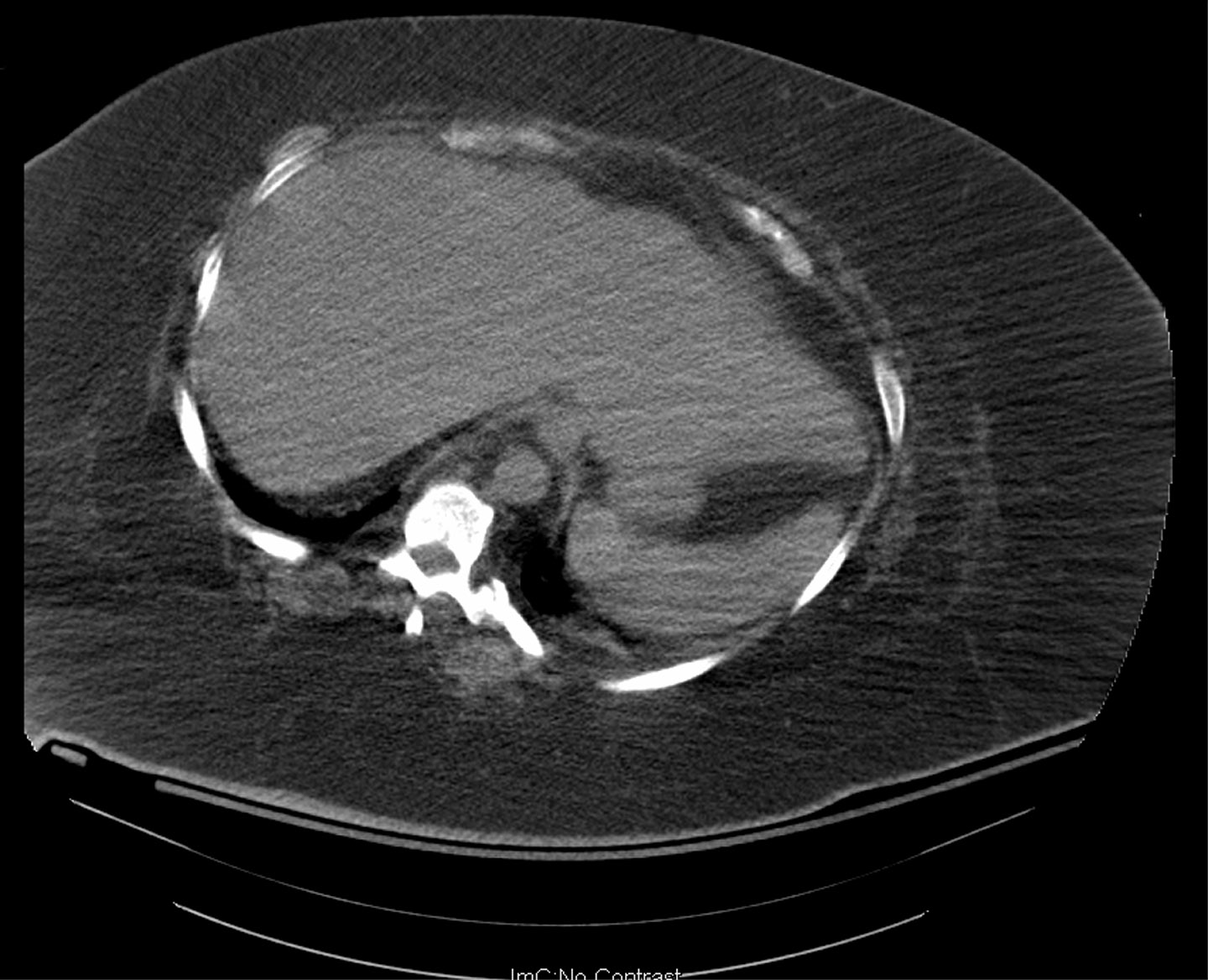
You can see that the organs are encased in body fat which extends to the limits (and beyond) of the CT scan table. The picture is grainy because the x-rays are partially absorbed by the thick fatty layer. This makes the interpretation of the images much more difficult. So not only is the diagnosis of abdominal problems hindered by the fat, you can imagine how hard surgery must be. Or maybe you can’t. Take my word for it, it’s hard.
Recovery is also an issue due to impaired wound healing, increased incidence of infections, problems moving the patient, difficult intravenous access and many more.
Remember this when you order that second Big Mac with supersized fries.
Friday, November 5, 2010
Key to Solving Obesity Crisis Discovered
Nov. 5, 2010. FLASH!!! From the EurekAlert! Website.
As confirmed by a group from Norway who studied 924 fourth-graders, overweight children have different eating patterns than normal weight children. Obese children ingest more sugar. In addition, they are less active and more likely to have obese parents.
I imagine that you are as astounded by these revelations as I am. Perhaps this is the spark that will ignite the reversal of the worldwide epidemic of obesity. All we need to do is get children to eat and drink less sugar, exercise more and convince their parents to lose weight.
Now that this is settled, let’s address the second most important health problem of this century, chapped lips. If we focus all of our resources on finding a cure, we should be able to lick chapped lips by the year 2020.
As confirmed by a group from Norway who studied 924 fourth-graders, overweight children have different eating patterns than normal weight children. Obese children ingest more sugar. In addition, they are less active and more likely to have obese parents.
I imagine that you are as astounded by these revelations as I am. Perhaps this is the spark that will ignite the reversal of the worldwide epidemic of obesity. All we need to do is get children to eat and drink less sugar, exercise more and convince their parents to lose weight.
Now that this is settled, let’s address the second most important health problem of this century, chapped lips. If we focus all of our resources on finding a cure, we should be able to lick chapped lips by the year 2020.
Tuesday, October 26, 2010
“Body Size Misperception” May Be a Factor Contributing to the Obesity Epidemic
Did you ever wonder, as I often have, what obese people are thinking as they keep putting on weight? Why doesn’t it occur to them as they pass, say 250 lbs., that maybe they should stop eating so much? As published two weeks ago in Archives of Internal Medicine*, researchers in Dallas suggest that a substantial number of obese people have what they term “Body Size Misperception.” More than 2000 obese adults were shown drawings of human figures on a 9 point scale, ranging from very thin to very obese. They then were told to pick both a figure that they felt would be ideal and a figure that represented how they thought they appeared. Body size misperception existed if the subject chose an ideal body size that was the same or larger than his/her actual size.
Some 8% of the group exhibited body size misperception. In other words, these people did not recognize that they were obese. Further examples of denial were that the body size misperception cohort felt they had a low lifetime risk of heart attack, high blood pressure and diabetes. The most amazing revelation is that a full two-thirds of these already obese individuals considered themselves at low risk for developing obesity. The authors of the paper think this issue is under-publicized and generally not dealt with well by physicians.
Maybe the concept of body size misperception, an entity that I certainly was not aware of before, can explain the apparent lack of self-recognition that one might be obese. And lacking the ability to see this obviously explains not only why some people become morbidly obese but also why they don’t seem inclined to correct the situation.
*Powell TM, et al. Body size misperception: a novel determinant in the obesity epidemic. Arch Intern Med. 2010 Oct 11;170:1695-7. [No abstract available]
Some 8% of the group exhibited body size misperception. In other words, these people did not recognize that they were obese. Further examples of denial were that the body size misperception cohort felt they had a low lifetime risk of heart attack, high blood pressure and diabetes. The most amazing revelation is that a full two-thirds of these already obese individuals considered themselves at low risk for developing obesity. The authors of the paper think this issue is under-publicized and generally not dealt with well by physicians.
Maybe the concept of body size misperception, an entity that I certainly was not aware of before, can explain the apparent lack of self-recognition that one might be obese. And lacking the ability to see this obviously explains not only why some people become morbidly obese but also why they don’t seem inclined to correct the situation.
*Powell TM, et al. Body size misperception: a novel determinant in the obesity epidemic. Arch Intern Med. 2010 Oct 11;170:1695-7. [No abstract available]
Wednesday, October 6, 2010
Monday, August 2, 2010
Frivolous Musings on Obesity from the New York Times
“Plus-Size Wars” in the August 1, 2010 issue of the New York Times magazine documents the travails of obese women looking for fashionable clothing and designers and manufacturers attempting to make clothes that fit. The article also mentions the burgeoning movement of the obese accepting their bodies and resisting the societal pressure to lose weight. If only the problem of obesity was limited to lack of suitable couture.
As a practicing general surgeon, I would like to point out that while obese people are coming to grips with their body images, they are also killing themselves. Just about everything involving medical care is exceedingly more difficult in the obese patient from the simple acts of having blood drawn, IVs inserted and blood pressure measured accurately to undergoing and recovering from even basic operations such as appendectomies.
Obesity is linked to decreased life expectancy and higher rates of diabetes, cancer, lung disease, hypertension and death from all causes. Finally, the cost of medical care is significantly higher for the obese. Compared to health, the clothing issue is of miniscule importance.
As a practicing general surgeon, I would like to point out that while obese people are coming to grips with their body images, they are also killing themselves. Just about everything involving medical care is exceedingly more difficult in the obese patient from the simple acts of having blood drawn, IVs inserted and blood pressure measured accurately to undergoing and recovering from even basic operations such as appendectomies.
Obesity is linked to decreased life expectancy and higher rates of diabetes, cancer, lung disease, hypertension and death from all causes. Finally, the cost of medical care is significantly higher for the obese. Compared to health, the clothing issue is of miniscule importance.
Subscribe to:
Posts (Atom)